
Making a Strong Prompt for Important Alerts
Contents of this article
Why use the AI feature?
Our AI feature makes sure you only receive alerts for the changes that are actually important to you, so you don't have to go through an email for every little change. It's simple: in the Alert me when field, tell our AI in plain language what matters to you, and it takes care of the rest.
But how do you write a good prompt? How can you make sure Visualping accurately captures the changes you want?
This article is here to help. By the end, you'll know what to keep in mind to write prompts that work.
Note: AI prompts and summaries are available on all plans, including Free.
Pro tip: Need to add the same prompt to several monitors? If you are on a Business plan, you can save time by using the bulk editing tool to update all of them in one go.
Tips and tricks for writing your prompt
Step 1:
Start with our AI suggestions
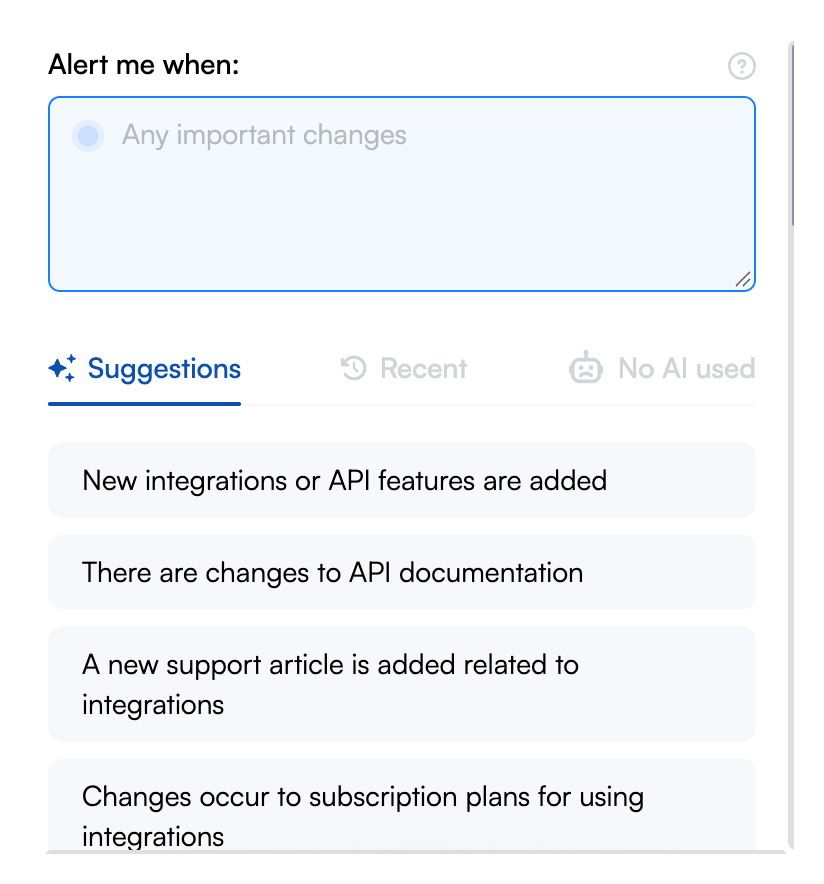
When you enter a new URL into Visualping, our AI analyzes the page and suggests what you may want to track. Browse these under the Suggestions tab in the prompts panel. Check the Recent tab to reuse prompts you've applied to other monitors.
If one of these suggestions is right for you, that's great, and you can skip the rest of the steps. Otherwise, pick the closest prompt or start from scratch, then keep reading.
Step 2:
Make it specific
Your prompt needs to clearly tell Visualping what to look for. Be specific and concise. Think of it like writing a note to a smart assistant: the clearer you are, the better your results.
Vague: "The change is important when there's a website change."
Clear: "The change is important if there is a product price change, or if the 'Out of stock' label appears."
Step 3:
Monitor keywords and phrases
You can tell the AI which keywords or phrases you're waiting to be added or removed. For example, alert me when "a new article comes out containing the words 'hello', 'world' or 'hello world!'".
Tip: The AI understands keywords in context, so it can also catch related wording. If you need exact, word-for-word matching instead, use keyword alerts with the Text changes compare mode.
Step 4:
Set "ignore" rules
Tell the AI which changes are unimportant to reduce false alerts. Use words like "ignore", "exclude", or "disregard" to show that those changes don't matter to you.
For example, alert me when "a new article comes out. Ignore new articles about baseball or celebrity news."
You can also tell the AI to ignore changes in formatting, punctuation, or headers and footers.
Step 5:
Choose a summary format
By default, you get a 1–2 sentence summary of the changes and why they're important based on your prompt. You can also tell the AI to organize the summary so it's easier to read at a glance.
You can request specific formats, such as a particular language, tables, bulleted lists, or a custom template. For example:
Specific language: "The summary should be in Spanish."
By default, the summary is generated in English. However, if you monitor websites in another language, the summary may sometimes appear in that language. If you want the summary strictly in English, include that instruction in the prompt. Likewise, you can specify any language to make sure the summary is in the language that's easiest for you.
Table: "Give me the summary of the changes in a table with three columns: author, title, and summary."
Bulleted list: "Summarize the changes in 3 bullet points, followed by a one-sentence 'Business Impact' statement."
Custom format: "The summary should be in the format: 'title' by 'author', then the 'summary'."
Note: Tables, lists, and other formatting appear in your alerts and on the dashboard. In scheduled report emails, summaries are shown as plain text.
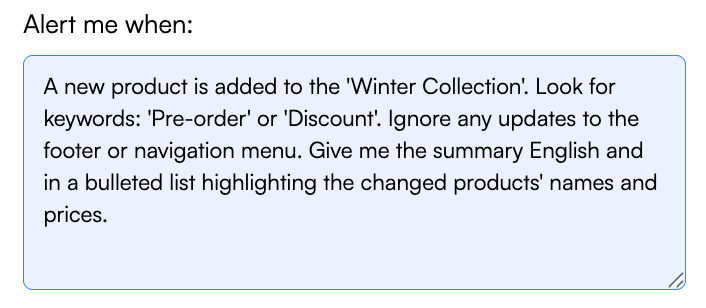
Putting it all together, your prompt might look like this:
Alert me when "A new product is added to the 'Winter Collection'. Look for keywords: 'Pre-order' or 'Discount'. Ignore any updates to the footer or navigation menu. Give me the summary in English and in a bulleted list highlighting the changed products' names and prices."
Pro tip: When summarizing a new change, the AI also looks at your monitor's previous change summaries. This lets it compare what changed now with what changed before, so summaries become more accurate over time. To get the most out of this, write prompts that describe an ongoing trend, not just a one-time state. For example: "Alert me when the pricing plan tier names or prices change compared to previous changes."
Want smarter alerts without writing prompts?
On the Solutions plan, we'll do the heavy lifting for you. You get all the features included in the Business plan, plus:
AI concierge service: Our team works with you to understand what you care about on the page, then builds and optimizes your AI prompts on your behalf.
Fully managed onboarding and support: Including setup, onboarding, training, account management, and hands-on troubleshooting.
Custom data extraction and structured output: Get summaries that include the content you care about, along with extracted data in your own custom format.
Extracted data can trigger automation workflows in your own systems or in tools like Zapier, n8n, and Make.
You can also send alerts to Google Sheets for further spreadsheet analysis.
The ability to scale up with AI prompts applied across your workspace, and web monitoring for any usage need: thousands of pages, millions of checks, or dozens of team workspaces.
Upgraded AI models: On request, access premium large language models for more accurate and customized change summaries.
Pre-set data starter packs: Kick off your monitoring project with a curated set of web pages tailored to your use case, industry, and area of focus. For example, public SaaS pricing or global environmental regulations.
The Solutions plan is the right choice when AI precision, custom configurations, and dedicated service are critical to your monitoring goals.
Reach out to our team about the Solutions plan for more powerful, hands-off web monitoring.
My prompt is amazing but I still get false alerts, what can I do?
Is something on the page distracting the AI?
Popups, ads, and cookie banners can cause false alerts. See Using the block action to hide them.
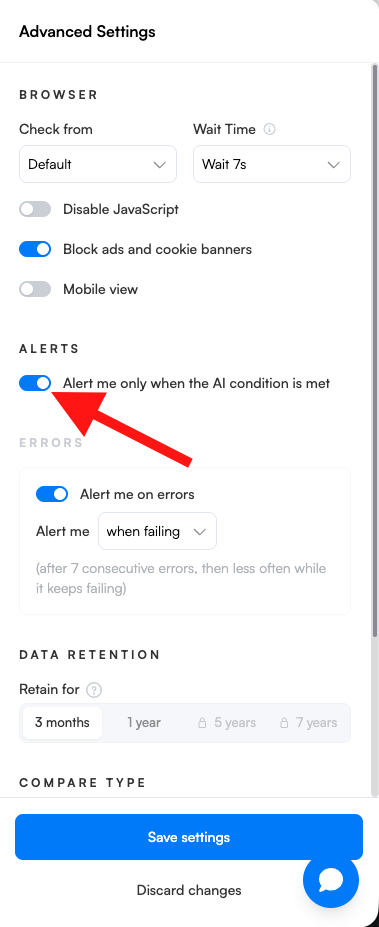
Is "Alert me only when the AI condition is met" turned off?
This setting is on by default and turns on automatically when you write a prompt or choose Any important changes. If it's been turned off, you'll be alerted for every change, not just important ones. Turn it back on in your monitor's settings.
Rate your alerts. Use the 👍 / 👎 feedback buttons on your alerts to tell us when the AI got it right or wrong.
Check out our article on reducing false alerts.
Frequently Asked Questions
How long can my prompt be?
Up to 16,000 characters. If your prompt goes over the limit, a counter appears under the field and you won't be able to save until you shorten it. Shorter, focused prompts usually work best.
Why can't I edit my "Alert me when" field?
Your monitor uses a prompt set up for you by our team. To change it, contact our Support team at support@visualping.io.
Can I get alerts for every change, without AI?
Yes. Choose Any changes in the No AI used tab of the prompts panel. Be aware that this may generate more alerts.