
How do I set up single sign-on?
Contents of this article
What is SSO?
SSO, or Single Sign-On, allows you to log in once with a single set of credentials to gain access to all your different connected applications and services. It's like having one master key that unlocks every door in your building so you don't have to carry around a heavy keychain of individual passwords.
How to set up SSO with Visualping
Note: If you sign in with a personal Google account, you can use the Continue with Google button directly on the Visualping login page — no additional setup required. The enterprise SSO instructions below apply to organizations integrating their own identity provider (such as Okta, Azure AD, or Google Workspace) via SAML or OIDC.
Note: If you signed up via Google or enterprise SSO, you can now set a password from Settings > Profile. This gives you an additional login method alongside SSO — your existing SSO setup is not affected.
SAML connections
To establish trust between our platform and your identity provider you have to reach out to us at support@visualping.io providing the following information:
Metadata file — This file has to be generated on your side within your identity provider system. This file should contain a claim with an email following that schema. For example http://schemas.xmlsoap.org/ws/2005/05/identity/claims/emailaddress
Email domain(s) — The domain (or domains) that your users will use to sign in, which your identity provider controls. For example, if your company uses emails like name@example.com and name@example.org, you should provide both example.com and example.org.
To create the metadata file you'll need the following Visualping information:
Application ACS URL — https://amplifyidbroker-vpprod.auth.us-west-2.amazoncognito.com/saml2/idpresponse
Application SAML audience — urn:amazon:cognito:sp:us-west-2_wT0cLro2j
Note: Only users associated with the Visualping Business account can log in via SSO or standard email and password login. Account Admins can manage the users by following the steps here.
If users want to login via a specific platform (Okta, Google, Azure), please setup a bookmark that redirects to the custom link provided in the format of https://visualping.io/customer-sso?login=domain_name.
⚠️ Using Google Workspace or Okta? These providers require additional mandatory configuration steps before SSO will work correctly. See the sections below before submitting your metadata file.
🚨 For Google Workspace users
When configuring the SAML app in Google Workspace, you must map the correct attribute to the email claim Visualping expects. In the Attribute mapping section of your SAML app settings, add the following mapping:
Google Directory attribute:
Primary emailApp attribute:
http://schemas.xmlsoap.org/ws/2005/05/identity/claims/emailaddress
Without this mapping, Visualping will not be able to identify the user's email address from the SAML assertion and login will fail.
🚨 For Okta users
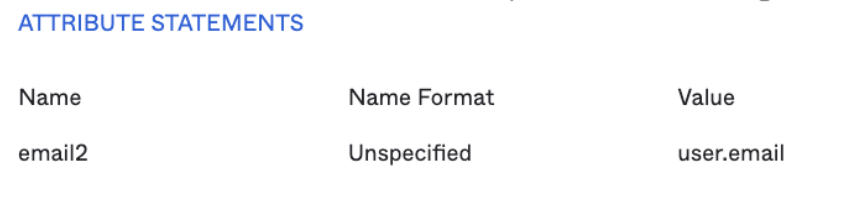
When configuring the SAML app in Okta, you must add a custom Attribute Statement so that Visualping receives the user's email address correctly. In the SAML Settings > Attribute Statements section, add the following:
Name:
email2Value:
user.email
The screenshot below shows the required configuration:
Without this attribute statement, Visualping will not be able to identify the user's email address from the SAML assertion and login will fail.
OIDC connections
We do not yet have customers integrated with OIDC. If your SSO protocol is OIDC, please contact support@visualping.io to start this process.